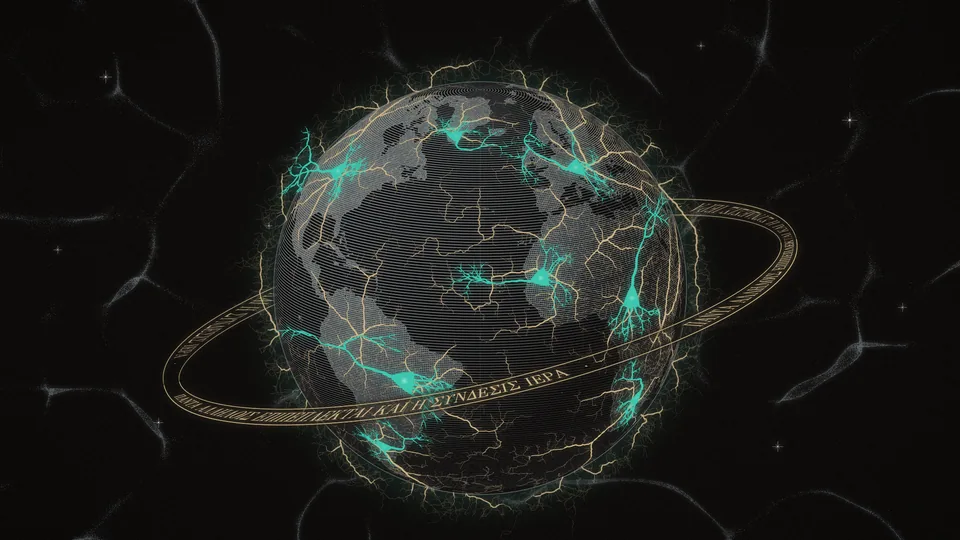
In the first two parts of this series the fungus was a teacher and silicon was the student. Part 1 showed that AI hardware wastes most of its effort moving data. Part 2 showed how a mycelium builds cheap, robust networks with one local rule: reinforce what carries flow, recycle what does not. This last part takes a bolder step. What if the student were alive?
The idea has an appealing shape. Picture the soil of the whole planet threaded with fungal filaments that trade water, sugar and signals between trees, a natural internet sometimes called the wood wide web. Now replace the fungus with human neurons, the cells that already compute inside our heads, and let that network grow, repair itself and learn, with no center and no limit. Would it become a biocomputing singularity, a living intelligence that outgrows its makers?
Should we take the fungus literally? Partly. Where biology allows, real mycelium appears in the design. Everywhere else the fungus is a blueprint, a set of rules for growing a network. To know which rules are worth copying, we first need to know what the planetary fungal network really is.
1 · Is there one fungal network around the planet?
In total, fungal mycelium is staggering. A 2026 global survey estimated that the topsoils of the world hold about 110 quadrillion kilometers of living hyphae from arbuscular mycorrhizal fungi alone, the group that partners with most plants, weighing around 300 million tonnes [1]. About 85% of vascular plant species form partnerships with fungi of this kind or others [2], and plants hand an estimated 13 billion tonnes of CO₂-equivalent a year to their fungal partners [3].
But a sum is not a network. Fungi recognize self from non-self. When hyphae from two genetically different individuals of the same species meet, recognition systems usually reject the fusion, and the joined segment is sealed off and dies [4, 5]. Different species never fuse at all. Most mycorrhizal individuals are therefore small: one of the largest ever mapped, a Suillus pungens, measured about 40 by 14 meters [6]. The giants are pathogens of wood. An Armillaria ostoyae in Oregon is genetically one individual across about 965 hectares, with samples 3.8 kilometers apart and an estimated age of 1,900 to 8,650 years [7]. One in Michigan covers about 75 hectares, weighs at least 400 tonnes and has been growing for at least 2,500 years [8].
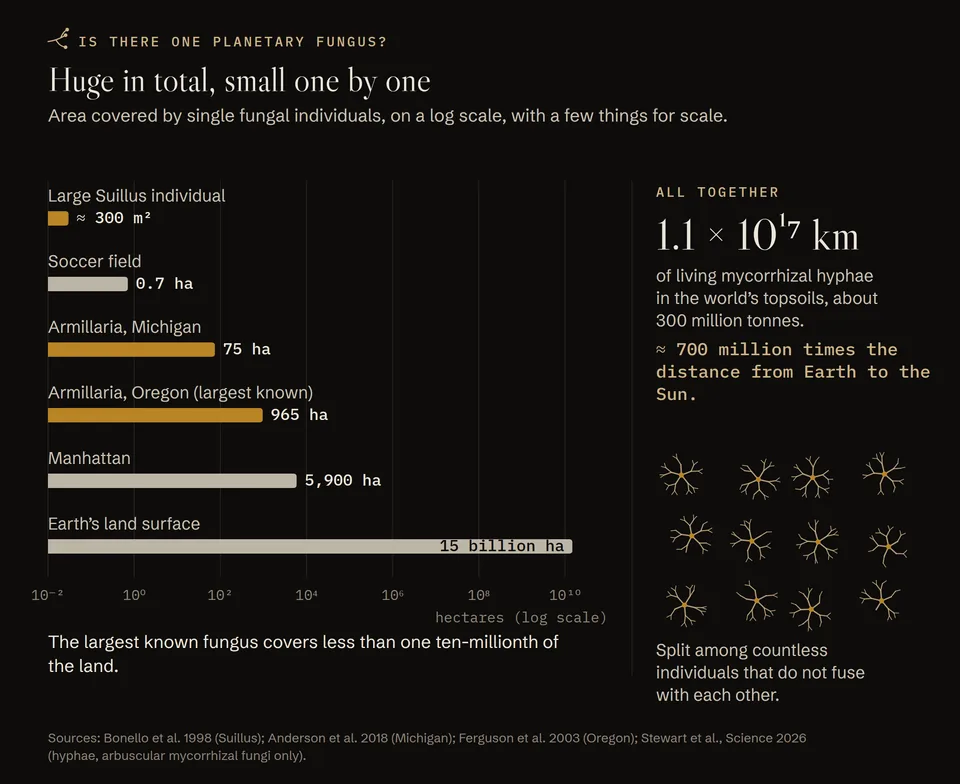
Inside a forest, the connections are real but local. In a 30-by-30-meter plot of Douglas fir, a single tree shared fungal individuals with 47 others [9]. Labeled carbon fixed by one tree has been traced into the fine roots of its neighbors, up to about 40% of their fine-root carbon in a Swiss forest [10], a line of research Suzanne Simard opened in 1997 [11]. What remains unproven is the popular story built on top: a 2023 review found insufficient evidence that such networks are widespread or that they help seedlings, and no peer-reviewed evidence that mother trees feed or warn their offspring through them [12].
So the planet is wrapped not in one fungal brain but in an archipelago of networks: dense inside each individual, joined loosely through shared roots, separated by boundaries that biologists think also help keep parasites and viruses from spreading [4]. For anyone designing a large living computer, that is the first and most useful lesson. Grow locally, connect where it pays, and keep firewalls.
2 · Living neurons on chips, today
The neural half of the idea is no longer science fiction. Organoid intelligence is the name for using living human neurons, grown from stem cells into flat cultures or small three-dimensional clusters called organoids, as a computing substrate [13]. In 2022 a dish of about 800,000 cultured neurons on an electrode array showed what its authors called “apparent learning” of the video game Pong within five minutes [14], a result later criticized for describing the cultures as “sentient” [15]. In 2023 a brain organoid used as a physical reservoir, with a trained digital readout, identified which of eight speakers had produced a vowel recording with about 78% accuracy, where chance is 12.5% [16].
There are commercial platforms too. FinalSpark lets researchers stimulate 16 organoids over the internet [17]. Cortical Labs’ CL1, launched in 2025 at about US$35,000 per unit, holds neurons on a 59-electrode chip with life support built in, according to company figures reported in the press [18]. In a 2026 study from UC Santa Cruz, organoids grown from mouse stem cells learned to balance a virtual pole, succeeding 46% of the time with adaptive training against 4.5% with random training, but the learning faded after about 45 minutes of rest [19].
All of these are small systems doing toy tasks, and claims that living neurons are “a million times more efficient” than chips have not been shown on comparable work [20]. Still, the pieces exist: neurons that can be grown, stimulated, read and trained in a loop with silicon.
3 · Five fungal rules, translated into neurons
What would it mean to wire those neurons the way a fungus wires a forest? Here are the five rules from Part 2, and how far neurons can follow each one.
- Grow toward what is needed. A fungus extends new tips toward food. Developing neurons also extend axons along chemical cues, but slowly: in culture, growing axons advance on the order of a fraction of a millimeter a day [21]. And mature neurons do not divide [22]. A mycelium can keep adding cells at its edge for centuries; a network of neurons can only grow by bringing in new tissue.
- Fuse. Hyphae fuse into a mesh. Organoids can be joined too. When two organoids were linked by a bundle of axons growing in both directions, the pair produced more complex activity than single or simply fused organoids [23], and researchers have chained four kinds of tissue into an assembloid that reproduces a whole sensory pathway, from sensory neurons to the cortex [24].
- Reinforce what is used. Fungal cords thicken where flow is high [25]. Synapses strengthen when the neurons on both sides fire in close succession, within about 20 milliseconds [26]. This is the rule neurons follow best.
- Recycle what is not. A mycelium reabsorbs idle threads and reuses their material. Neural circuits also prune connections, but a dead neuron in a dish is not replaced.
- Feed through the network. This is the rule neurons fail. A mycelium is its own plumbing: cytoplasm and nutrients flow through it, in cords at up to about 5 centimeters an hour [27]. Neural tissue depends on blood vessels. Without them, oxygen and nutrients diffuse only about 0.3 millimeters into tissue [13], so organoids stall at a few millimeters and die from the center outward [28]. Engineered vessel-like networks reduce that death [29], and organoids transplanted into a rat’s brain are invaded by its blood vessels, mature and even respond when the animal’s whiskers are touched [30], but no one can yet grow a perfused neural network in a dish.
That last rule is where the fungus might help literally. Fungal and slime-mold networks are good templates for plumbing that balances cost against robustness [31, 32], and mycelium has been tested as a living scaffold for human skin cells [33]. Nobody, as far as I could find, has grown neurons on mycelium. It is an open experiment, with risks covered below.
4 · The arithmetic of a brain-sized living network
Suppose the rules worked. How big would a living network have to be to match one human brain, with its roughly 86 billion neurons [34]?
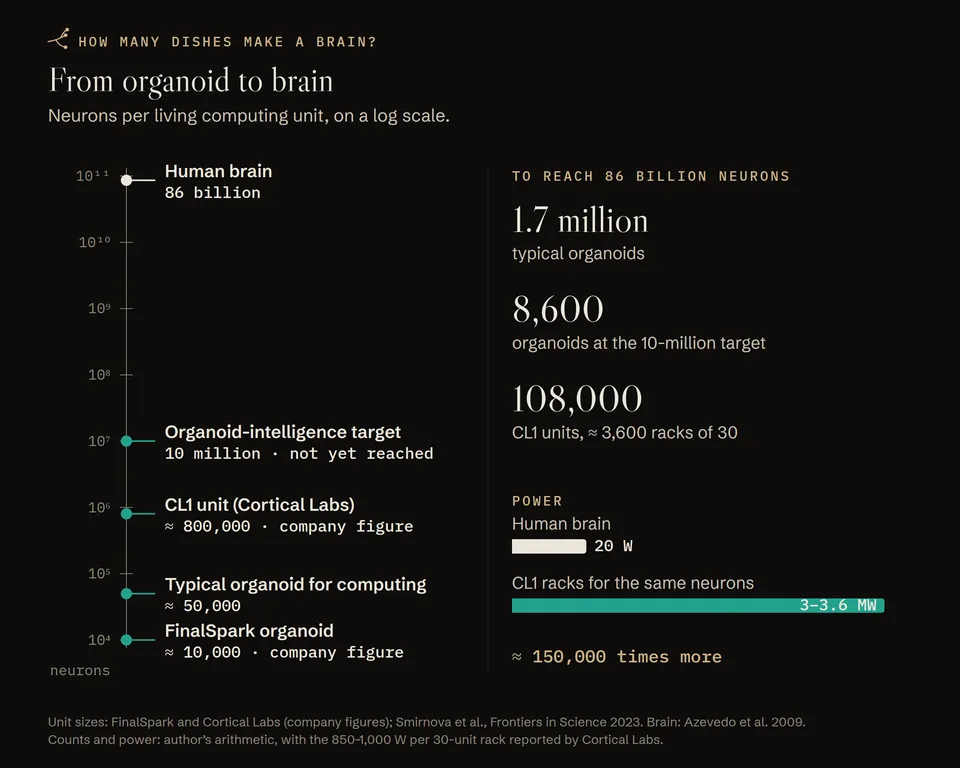
Today’s organoids used for computing hold around 50,000 cells, and the organoid-intelligence roadmap sets a target of about 10 million [13]. At 50,000 cells, a brain’s worth of neurons would take about 1.7 million organoids; at 10 million, about 8,600. With CL1 units at 800,000 neurons each [18], it would take about 108,000 units, or about 3,600 racks of 30. At the 850 to 1,000 W per rack that the company reports, life support and electronics alone would draw 3 to 3.6 megawatts, more than 150,000 times the 20 watts of the brain they imitate [35]. Divided evenly, the brain spends about a quarter of a billionth of a watt per neuron, a budget that is remarkably similar across species [36]. A dish cannot come close, because what costs energy is not the neurons but the incubator around them.
5 · Six walls between a living network and a singularity
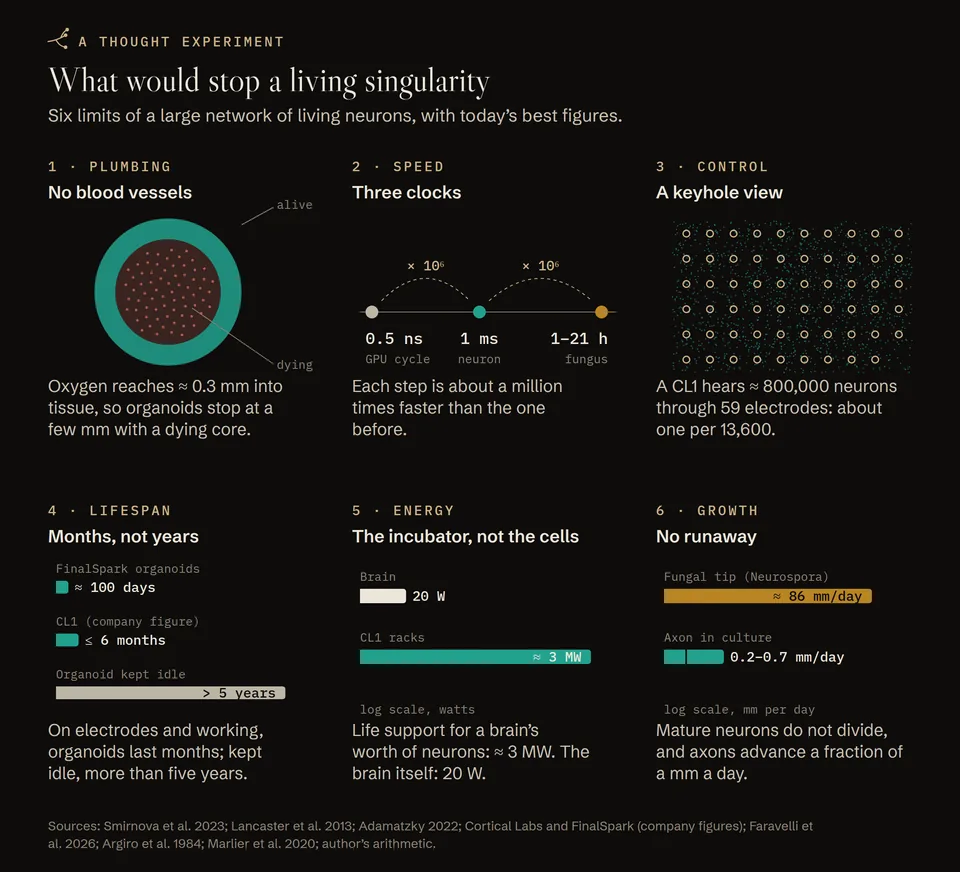
Plumbing. Without blood vessels there is no large living network, only many small ones.
Speed. The main obstacle for fungal computing is often summarized like this: fungi react and grow at a biological pace of minutes or hours, infinitely slower than the nanoseconds of silicon, so for now they are good for environmental sensors and low-power adaptive processing, far from replacing the data centers of generative AI. The direction is right, with two refinements. The gap is enormous but finite: fungal spikes recur every few minutes in some species and last up to about 21 hours in others [37, 38], a neural spike lasts about a millisecond, a GPU clock cycle about half a nanosecond, and each step is roughly a factor of a million. And neurons sit in the middle of that ladder, which is why they, and not fungi, are the natural living layer for anything that must react in real time.
Control. A CL1 listens to about 800,000 neurons through 59 electrodes [18], roughly one electrode for every 13,600 neurons. We can nudge such a network and read its mood; we cannot address its parts.
Lifespan and drift. Organoids on FinalSpark’s platform have lasted around 100 days [17], and Cortical Labs says the CL1 keeps neurons alive for up to six months [18]. Brain organoids can survive for more than five years in culture [39], but not while wired to electrodes and doing work. Living layers forget, as the UC Santa Cruz organoids did after 45 minutes, and they die.
Energy. As computed above, the cost is the life support, not the neurons.
Growth. A singularity, in the usual telling, needs a system that improves itself faster than its makers can follow. A network of neurons cannot even enlarge itself: it does not divide, it grows axons by fractions of a millimeter a day and it needs feeding by hand. If it ran away, it would be at the speed of a gardener.
6 · A realistic version: silicon, neurons and mycelium at their own tempos
Could a hybrid of fungi, silicon and human neurons get around these walls? It would not make living tissue fast. At most, it could stop asking it to be fast and give each part a job that suits its tempo.
One tempting argument should be resisted. Brains and machine-learning systems do combine fast and slow learners [40, 41], but that argues for slow variables, not slow substrates, and a slow variable is trivial in silicon. A living layer earns its place only by doing something silicon cannot do cheaply, such as sensing its surroundings in place or adapting its own wiring.
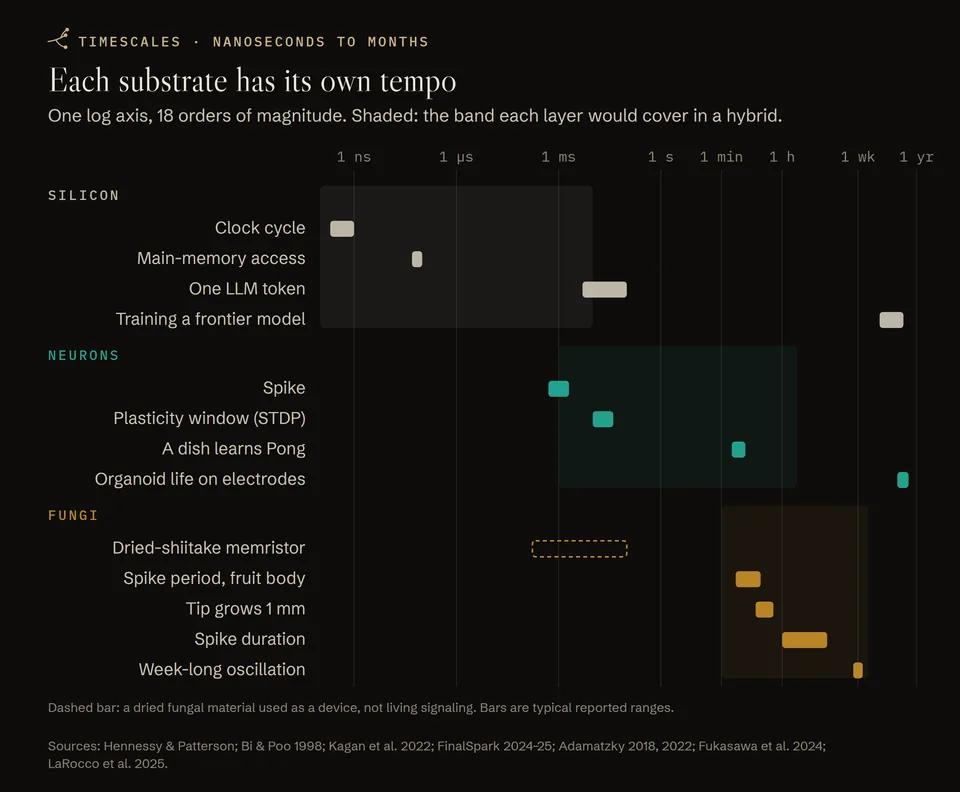
With that caveat, here is a three-layer design, offered as a thought experiment and not as a system anyone has built.
- L0, silicon (nanoseconds to milliseconds). Runs every real computation, including any generative model. Translates between tempos, keeps both living chambers alive and can override any biological output.
- L1, neurons (milliseconds to hours). Organoids on electrode arrays at 37 °C, as in DishBrain, Brainoware, CL1 and FinalSpark: a small adaptive module for closed-loop control and a physical reservoir. Shown only on toy tasks and never benchmarked against software.
- L2, mycelium (minutes to weeks). A living mycelium in its own enclosure at room temperature, deployed where it senses: a building, a field, a wearable. It would provide distributed sensing of moisture, light, load and chemicals [42, 43], and perhaps a slow integrator, although its memory capacity has never been measured.
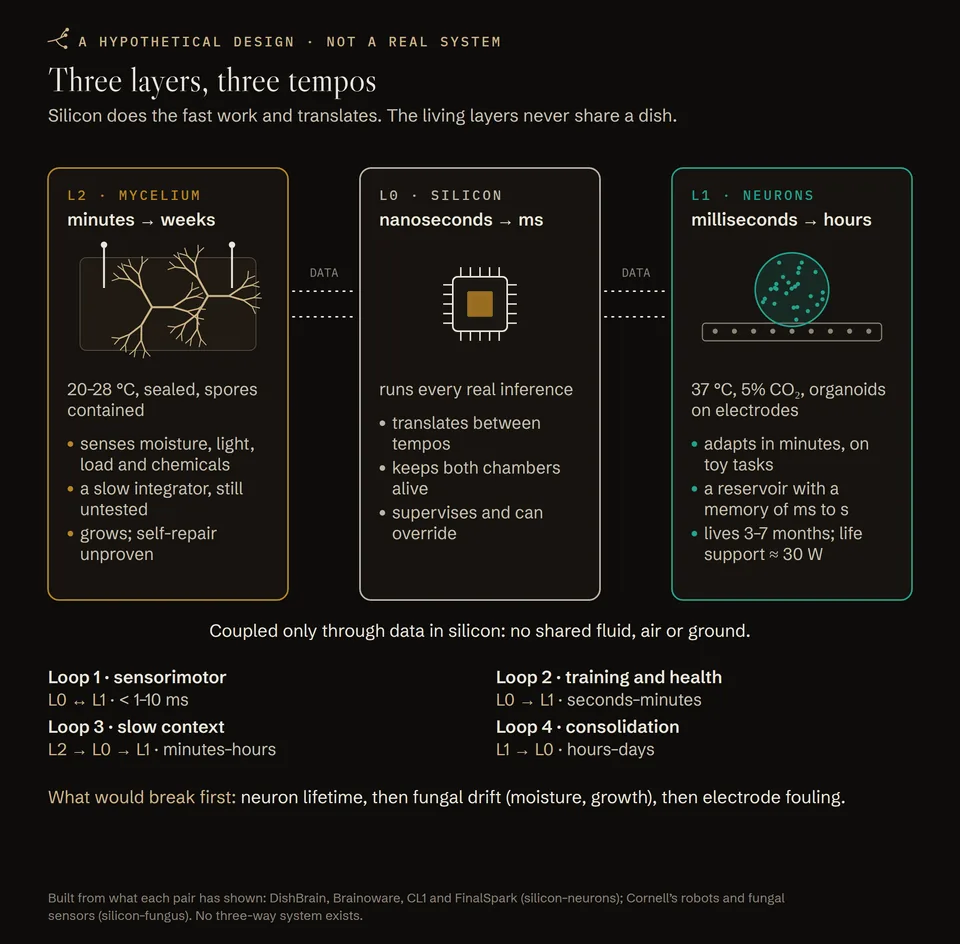
The two living layers should never share a dish. Human neurons need 37 °C and sterile media for months, and the fungi used in fungal computing would overgrow such a culture. Most fungi cannot grow at body temperature: in a test of nearly 4,800 strains, most failed at mammalian temperatures [44]. The ones that can are dangerous: in 2012, contaminated steroid injections in the United States caused 753 infections, mostly meningitis, and 64 deaths [45], and a pathogenic yeast invades and damages human brain organoids in the lab [46]. A serious design keeps the chambers physically separate, with no shared fluid, air or electrical ground, and couples them only through data.
The decisive experiment is an ablation, with its success criteria written down before it starts. Replace each living layer with software or a cheap conventional sensor, and include a dead, sterilized mycelium panel to separate living activity from the chemistry of wet electrodes. If the hybrid does not beat those replacements on accuracy per watt, life support included, the living layer adds no computational value, however fascinating it is.
7 · So, a singularity?
The idea of a singularity has two classic sources. In 1965, the statistician I. J. Good argued that an ultraintelligent machine could design even better machines, setting off an “intelligence explosion”, and he added a condition that is usually forgotten: “provided that the machine is docile enough to tell us how to keep it under control” [47]. In 1993, the mathematician and novelist Vernor Vinge listed several routes to superhuman intelligence, among them large computer networks that might “wake up” together with their users, and biological science improving on the human intellect [48].
A network of neurons grown on fungal rules fails the first condition of that story. It cannot improve itself quickly because it cannot even grow quickly, and it depends on plumbing nobody can yet build, on electrodes that hear a tiny fraction of it and on costly life support. If something like a singularity ever comes from biology, it will look like a symbiosis: silicon for speed and memory, living tissue for adaptation and sensing, each kept alive by the other.
Good’s second condition, docility, becomes an ethical one. The US National Academies judged in 2021 that it is extremely unlikely that neural organoids will, in the foreseeable future, have capacities recognizable as awareness, consciousness or pain [49]. That judgment was made for small, isolated organoids. A network built to grow, connect and learn is exactly the case in which it should be checked rather than assumed, and researchers have proposed ways to measure signs of consciousness in organoids [50]. The Baltimore Declaration asks that organoid intelligence build ethics in from the start [51], and the UK’s Nuffield Council has called for clearer rules on consent and on when consciousness might be attributed [52]. People who donate cells should know that those cells may become part of a computer.
Closing: what the forest actually teaches
This series began with a chip that spends its life waiting for data and ended with a thought experiment about living computers. The fungus has been a guide all the way, and its last lesson is the most surprising. The forest floor is not one planetary brain. It is many local networks, each growing at its own pace, joined where it pays and separated where it must be.
That is a good design for AI hardware, where memory and computation should live close together and no single cable should carry everything. It is also the only sane design for any living computer we might build: small, separated, supervised and measured before it is trusted. The singularity, if it comes, will not grow out of the soil. But the soil has a great deal to teach whoever builds it.
Notes on methods
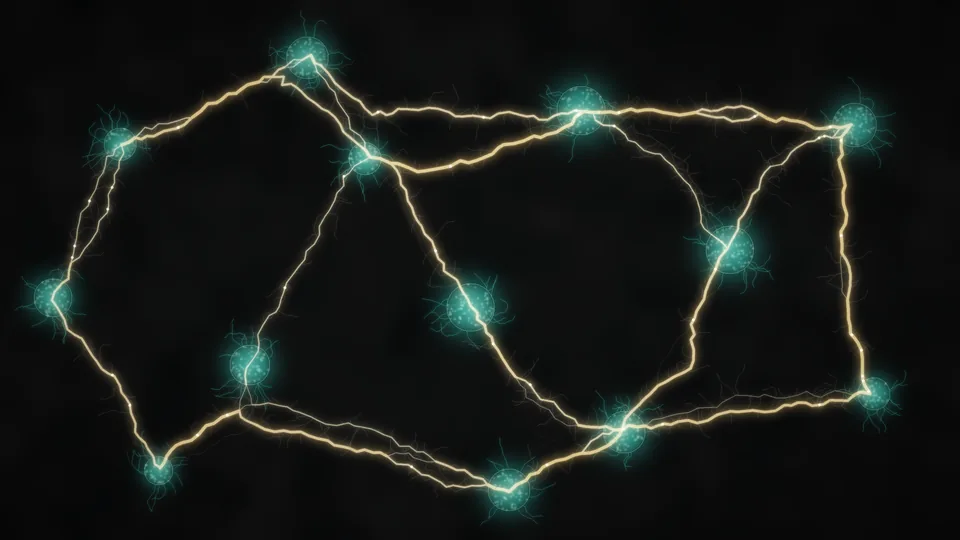
The cover is a collage made by computer for this series: the Earth engraved by a program from Natural Earth coastlines (public domain), neurons drawn by a program in the manner of Cajal, and a mycelium grown by an algorithm over the sphere. The ring carries a line from Marcus Aurelius in the original Greek, “all things are interwoven, and the bond is sacred” [53]; the background is a cosmic web generated with the Zel’dovich approximation, a nod to a study that compared the large-scale structure of the universe with the brain’s network of neurons [54]. The “Neurons on a fungal plan” figure is an original computer simulation: clusters of neurons are drawn as spheres, and the cords between them are grown with the adaptive-network rule of Tero et al. (2010), dD/dt = |Q|^μ / (1 + |Q|^μ) − D with μ = 1.25, on a random mesh. The counts in section 4 are my arithmetic: 86 billion neurons divided by 50,000, 800,000 or 10 million cells per unit; CL1 racks of 30 units at the 850 to 1,000 W per rack reported by the company; 20 W for the brain. Company figures for CL1 and FinalSpark are presented as such. Illustrations marked as generated with AI are artistic references, not scientific images.
References
- Stewart, J. et al. “Global density and biomass of arbuscular mycorrhizal fungal networks.” Science 392(6803): 1171–1176, 2026. DOI
- Brundrett, M. C. and Tedersoo, L. “Evolutionary history of mycorrhizal symbioses and global host plant diversity.” New Phytologist 220: 1108–1115, 2018. DOI
- Hawkins, H.-J. et al. “Mycorrhizal mycelium as a global carbon pool.” Current Biology 33(11): R560–R573, 2023. DOI
- Saupe, S. J. “Molecular genetics of heterokaryon incompatibility in filamentous ascomycetes.” Microbiology and Molecular Biology Reviews 64(3): 489–502, 2000. DOI
- Worrall, J. J. “Somatic incompatibility in basidiomycetes.” Mycologia 89(1): 24–36, 1997. DOI
- Bonello, P., Bruns, T. D. and Gardes, M. “Genetic structure of a natural population of the ectomycorrhizal fungus Suillus pungens.” New Phytologist 138: 533–542, 1998. DOI
- Ferguson, B. A. et al. “Coarse-scale population structure of pathogenic Armillaria species in a mixed-conifer forest in the Blue Mountains of northeast Oregon.” Canadian Journal of Forest Research 33: 612–623, 2003. DOI
- Anderson, J. B., Bruhn, J. N., Kasimer, D., Wang, H., Rodrigue, N. and Smith, M. L. “Clonal evolution and genome stability in a 2500-year-old fungal individual.” Proceedings of the Royal Society B 285: 20182233, 2018. DOI
- Beiler, K. J., Durall, D. M., Simard, S. W., Maxwell, S. A. and Kretzer, A. M. “Architecture of the wood-wide web: Rhizopogon spp. genets link multiple Douglas-fir cohorts.” New Phytologist 185: 543–553, 2010. DOI
- Klein, T., Siegwolf, R. T. W. and Körner, C. “Belowground carbon trade among tall trees in a temperate forest.” Science 352: 342–344, 2016. DOI
- Simard, S. W. et al. “Net transfer of carbon between ectomycorrhizal tree species in the field.” Nature 388: 579–582, 1997. DOI
- Karst, J., Jones, M. D. and Hoeksema, J. D. “Positive citation bias and overinterpreted results lead to misinformation on common mycorrhizal networks in forests.” Nature Ecology & Evolution 7: 501–511, 2023. DOI
- Smirnova, L. et al. “Organoid intelligence (OI): the new frontier in biocomputing and intelligence-in-a-dish.” Frontiers in Science 1: 1017235, 2023. DOI
- Kagan, B. J. et al. “In vitro neurons learn and exhibit sentience when embodied in a simulated game-world.” Neuron 110(23): 3952–3969, 2022. DOI
- Balci, F. et al. “A response to claims of emergent intelligence and sentience in a dish.” Neuron 111(5): 604–605, 2023. DOI
- Cai, H. et al. “Brain organoid reservoir computing for artificial intelligence.” Nature Electronics 6, 2023. DOI
- Jordan, F. D., Kutter, M., Comby, J.-M., Brozzi, F. and Kurtys, E. “Open and remotely accessible Neuroplatform for research in wetware computing.” Frontiers in Artificial Intelligence 7: 1376042, 2024. DOI
- TechRadar. “A breakthrough in computing: Cortical Labs’ CL1 is the first living biocomputer.” March 2025 (company figures: price, 59-electrode array, rack power). techradar.com
- Robbins, A. et al. “Goal-directed learning in cortical organoids.” Cell Reports, 2026. Summary in News-Medical, 19 February 2026. news-medical.net
- Carlsmith, J. How Much Computational Power Does It Take to Match the Human Brain? Open Philanthropy, 2020. openphilanthropy.org
- Argiro, V., Bunge, M. B. and Johnson, M. I. “Correlation between growth form and movement and their dependence on neuronal age.” Journal of Neuroscience 4(12): 3051–3062, 1984. DOI
- Marlier, Q., D’aes, T., Verteneuil, S., Vandenbosch, R. and Malgrange, B. “Core cell cycle machinery is crucially involved in both life and death of post-mitotic neurons.” Cellular and Molecular Life Sciences 77: 4553–4571, 2020. DOI
- Osaki, T. et al. “Complex activity and short-term plasticity of human cerebral organoids reciprocally connected with axons.” Nature Communications 15: 2945, 2024. DOI
- Kim, J.-I., Imaizumi, K., Pașca, S. P. et al. “Human assembloid model of the ascending neural sensory pathway.” Nature 642: 143–153, 2025. DOI
- Heaton, L. L. M. et al. “Growth-induced mass flows in fungal networks.” Proceedings of the Royal Society B 277: 3265–3274, 2010. DOI
- Bi, G. and Poo, M. “Synaptic modifications in cultured hippocampal neurons: dependence on spike timing, synaptic strength, and postsynaptic cell type.” Journal of Neuroscience 18(24): 10464–10472, 1998. DOI
- Tlalka, M., Watkinson, S. C., Darrah, P. R. and Fricker, M. D. “Continuous imaging of amino-acid translocation in intact mycelia of Phanerochaete velutina reveals rapid, pulsatile fluxes.” New Phytologist 153: 173–184, 2002. DOI
- Lancaster, M. A. et al. “Cerebral organoids model human brain development and microcephaly.” Nature 501: 373–379, 2013. DOI
- Cakir, B. et al. “Engineering of human brain organoids with a functional vascular-like system.” Nature Methods 16: 1169–1175, 2019. DOI
- Revah, O. et al. “Maturation and circuit integration of transplanted human cortical organoids.” Nature 610: 319–326, 2022. DOI
- Tero, A. et al. “Rules for biologically inspired adaptive network design.” Science 327: 439–442, 2010. DOI
- Katifori, E., Szöllősi, G. J. and Magnasco, M. O. “Damage and fluctuations induce loops in optimal transport networks.” Physical Review Letters 104: 048704, 2010. DOI
- Antinori, M. E. et al. “Advanced mycelium materials as potential self-growing biomedical scaffolds.” Scientific Reports 11: 12630, 2021. DOI
- Azevedo, F. A. C. et al. “Equal numbers of neuronal and nonneuronal cells make the human brain an isometrically scaled-up primate brain.” Journal of Comparative Neurology 513(5): 532–541, 2009. DOI
- Balasubramanian, V. “Brain power.” PNAS 118(32): e2107022118, 2021. DOI
- Herculano-Houzel, S. “Scaling of brain metabolism with a fixed energy budget per neuron: implications for neuronal activity, plasticity and evolution.” PLoS ONE 6(3): e17514, 2011. DOI
- Adamatzky, A. “On spiking behaviour of oyster fungi Pleurotus djamor.” Scientific Reports 8: 7873, 2018. DOI
- Adamatzky, A. “Language of fungi derived from their electrical spiking activity.” Royal Society Open Science 9: 211926, 2022. DOI
- Faravelli, I., Antón-Bolaños, N., Arlotta, P. et al. “Human brain organoids record the passage of time over multiple years.” Nature, 2026. DOI
- McClelland, J. L., McNaughton, B. L. and O’Reilly, R. C. “Why there are complementary learning systems in the hippocampus and neocortex.” Psychological Review 102(3): 419–457, 1995. DOI
- Ba, J., Hinton, G., Mnih, V., Leibo, J. Z. and Ionescu, C. “Using Fast Weights to Attend to the Recent Past.” NeurIPS, 2016. arXiv
- Mishra, A. K. et al. “Sensorimotor control of robots mediated by electrophysiological measurements of fungal mycelia.” Science Robotics, 2024. DOI
- Phillips, N., Gandia, A. and Adamatzky, A. “Electrical response of fungi to changing moisture content.” Fungal Biology and Biotechnology, 2023. DOI
- Robert, V. A. and Casadevall, A. “Vertebrate endothermy restricts most fungi as potential pathogens.” Journal of Infectious Diseases 200: 1623–1626, 2009. DOI
- Centers for Disease Control and Prevention. Multistate outbreak of fungal meningitis and other infections: final case counts. archive.cdc.gov
- “Human Brain Organoids: A New Model to Study Cryptococcus neoformans Neurotropism.” Journal of Fungi 11(7): 539, 2025. mdpi.com
- Good, I. J. “Speculations Concerning the First Ultraintelligent Machine.” Advances in Computers 6: 31–88, 1965. DOI
- Vinge, V. “The Coming Technological Singularity: How to Survive in the Post-Human Era.” VISION-21 Symposium, NASA Lewis Research Center and Ohio Aerospace Institute, 1993. NASA CP-10129. ntrs.nasa.gov
- National Academies of Sciences, Engineering, and Medicine. The Emerging Field of Human Neural Organoids, Transplants, and Chimeras: Science, Ethics, and Governance. Washington, DC: The National Academies Press, 2021. DOI
- Lavazza, A. and Massimini, M. “Cerebral organoids: ethical issues and consciousness assessment.” Journal of Medical Ethics 44(9): 606–610, 2018. DOI
- Hartung, T. et al. “The Baltimore declaration toward the exploration of organoid intelligence.” Frontiers in Science 1: 1068159, 2023. DOI
- Nuffield Council on Bioethics. “Research using neural organoids: ethical considerations.” Policy briefing, March 2024. nuffieldbioethics.org
- Marcus Aurelius. Meditations, book VII, 9. Translated by George Long, 1862. lexundria.com
- Vazza, F. and Feletti, A. “The Quantitative Comparison Between the Neuronal Network and the Cosmic Web.” Frontiers in Physics 8: 525731, 2020. DOI