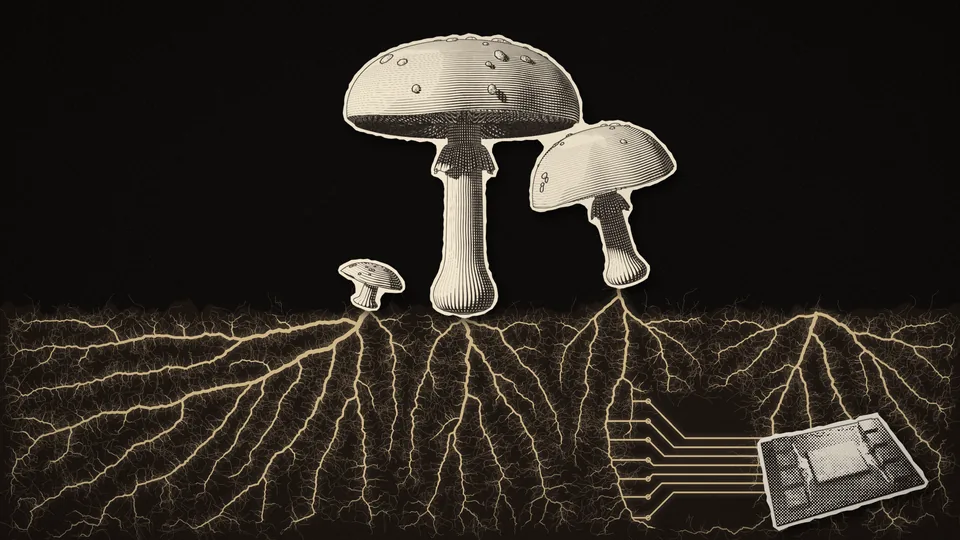
Under a forest floor there are networks nobody designed. They are made of hyphae, tubes a few thousandths of a millimeter wide that grow at their tips, branch and fuse with one another. Together they form a mycelium. It has no brain and no control center, yet it moves water and nutrients over long distances, routes around obstacles, repairs damaged connections and abandons the ones it no longer needs.
Part 1 of this series showed that AI hardware spends much of its energy moving data, and that the next gains will come from how computers are organized rather than from smaller transistors. The brain is one model of a better organization. This part looks at a second, stranger one.
One clarification from the start. Nobody is going to replace a GPU with a mushroom. What the mycelium offers is a way of organizing a network, and that can be studied, measured and imitated in silicon.
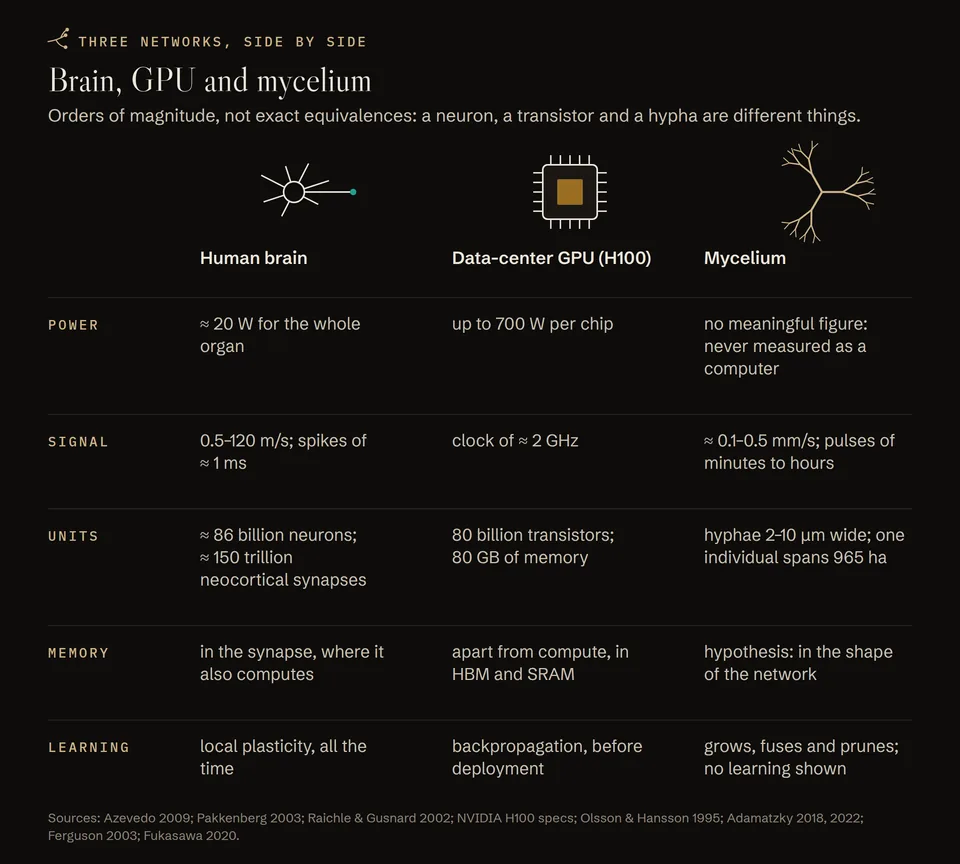
1 · A network without a center
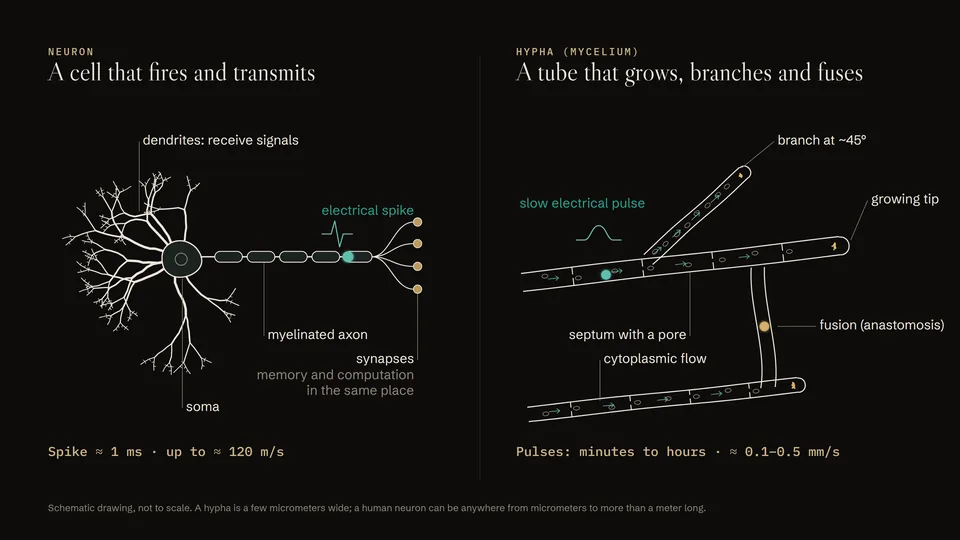
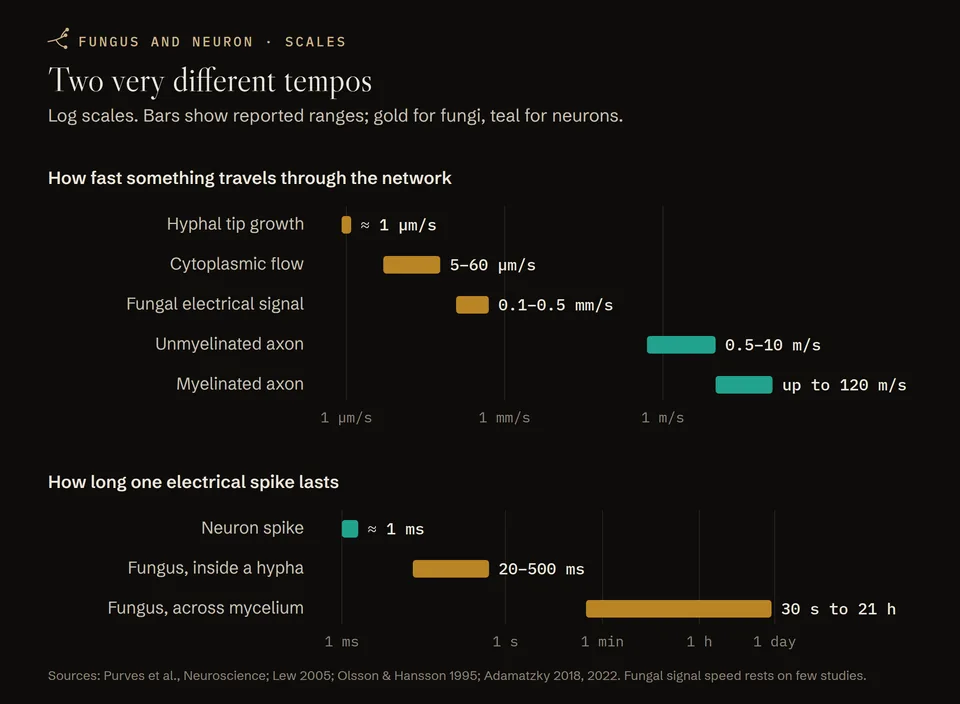
A fungus is, above all, a network. Its hyphae are tubes typically a few micrometers wide. They elongate only at their tips, branch behind the tip, and can fuse when they meet, a process called anastomosis that turns a branching tree into a mesh with loops [1]. Cytoplasm flows through the whole network, so the fungus can move nutrients and even nuclei from one end to the other without any vascular system. In the bread mold Neurospora, the bulk flow moves at about 5 micrometers per second [2].
For anyone who designs networks, the interesting part is how a mycelium decides what to keep. The process can be summarized in three phases.
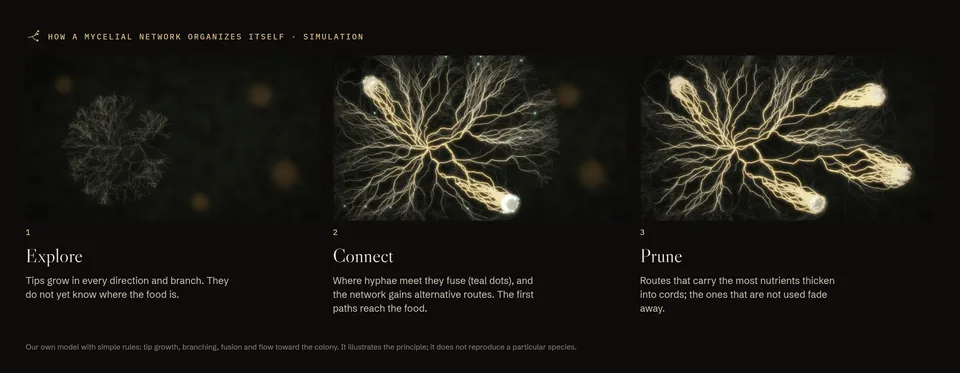
- Explore. At first, tips advance in many directions and the network is thin and even.
- Connect. When a hypha finds food, such as a piece of wood, the routes linking it to the rest of the colony gain importance, and fusions create alternative paths.
- Prune and reinforce. Cords that carry more flow thicken. The ones that are barely used are reabsorbed, and their material is recycled.
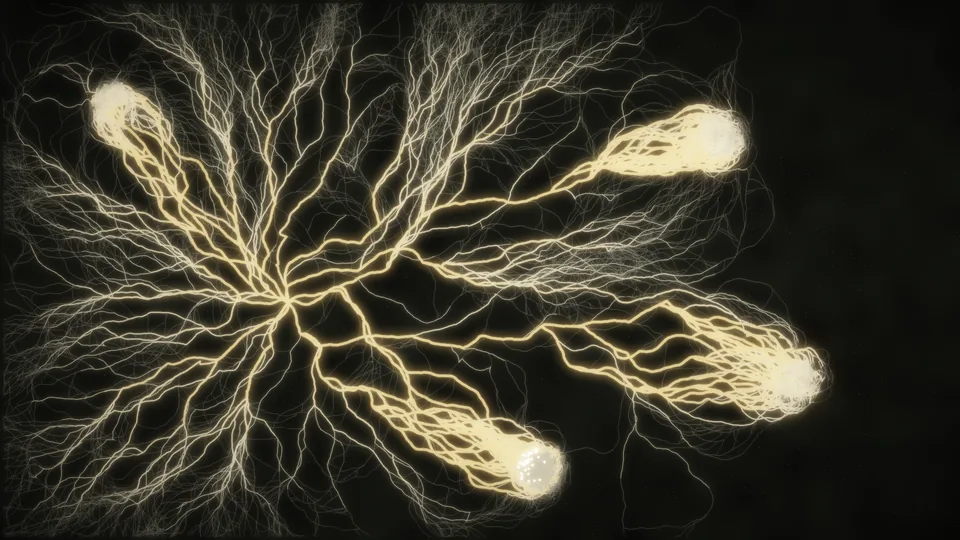
Work by Daniel Bebber, Mark Fricker and colleagues on the wood-decay fungus Phanerochaete velutina showed that these networks achieve high transport capacity and resistance to damage at the same time, and that their relative cost falls as they grow [3]. Luke Heaton and colleagues found that cords predicted to carry fast or large flows were more likely to increase in size [4]. It is a rule of reinforcement by use, similar in spirit to synaptic learning. In 2025 a team that used an imaging robot to track more than 500,000 nodes of growing mycorrhizal networks described their growth as self-regulating traveling waves: fusion keeps density in check, and new loops shorten routes without losing transport efficiency [5].
The rule is simple enough to simulate. The figure below uses the adaptive-network model that Atsushi Tero and colleagues wrote down in 2010, in which every tube’s conductance grows with the flow through it and decays when unused [6]. Started from a uniform mesh between nine food sources, the rule carves a lean network that keeps a few loops. When a wound cuts its busiest cord, flow shifts to a loop and the network keeps every food source connected.
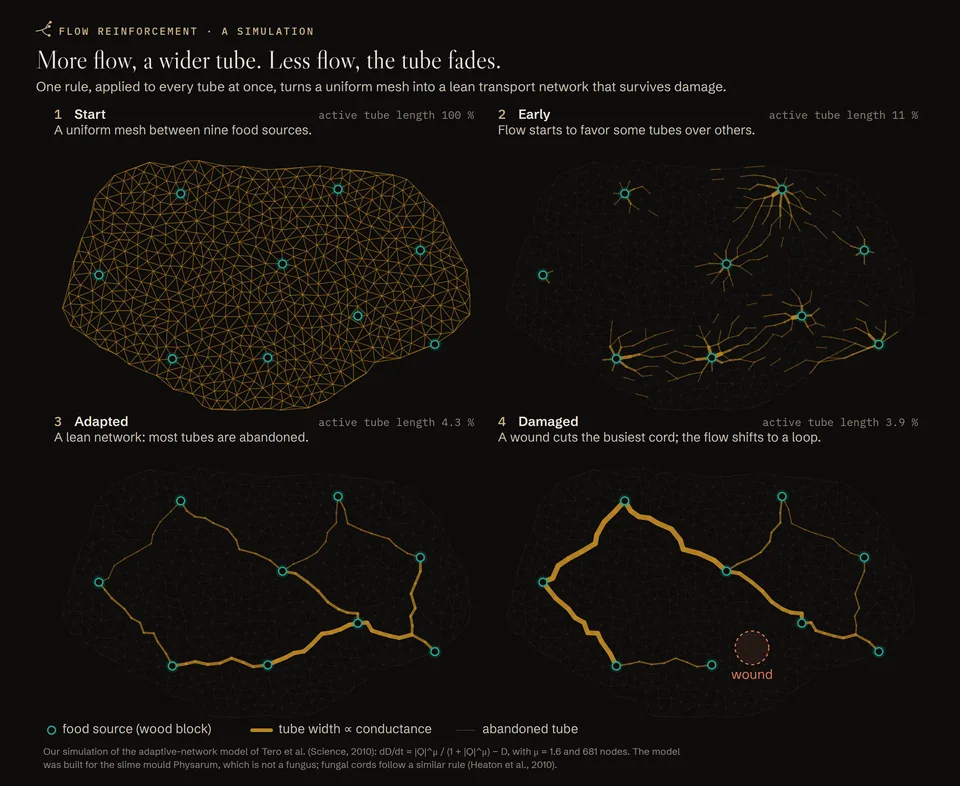
A frequent confusion deserves a sentence. The famous experiment that reproduced the Tokyo rail network with oat flakes did not use a fungus. Physarum polycephalum is a slime mold, a single-celled organism from a different branch of life [6]. It appears in these conversations because its growth rule closely resembles the one in fungal cords: more flow, a wider tube; less flow, the tube thins and disappears.
2 · An electrical network, at the pace of hours
The mycelium is also electrically active. In 1995, Stefan Olsson and Bill Hansson recorded impulses resembling action potentials in cords of Armillaria [7]. Later recordings found trains of spikes with periods of about 2.6 and 14 minutes in the fruit bodies of oyster mushrooms [8], and isolated spikes lasting from one to 21 hours, with amplitudes of 0.03 to 2.1 millivolts, across four other species [9]. A recording that ran for more than 100 days found an oscillation with a period of about a week [10]. Estimates of how fast these signals travel are on the order of a tenth of a millimeter per second, but they rest on very few studies.
There are suggestive results about memory. After a mycelium had colonized a new block of wood, the original block was moved, alone, to fresh soil, and new growth came mainly from the side that had faced the wood [11]. With the same amount of wood arranged in a circle or a cross, networks developed different structures and activity [12]. The authors themselves frame this with question marks, and the results still await independent replication.
One popular claim goes too far. A 2022 study grouped the electrical spikes of four species into up to 50 “words” [9]. Other researchers replied that calling this a language is premature and that some of the signals may be noise or artifacts of the setup [13]. Fungi signal; nobody has shown that they talk.
3 · Fungal computing today
Fungal computing exists as a research field. Its starting point is Andrew Adamatzky’s 2018 paper “Towards fungal computer”, which proposed treating the mycelium’s electrical spikes as signals and the network itself as a processor [14]. Several concrete results have followed, from his lab and others:
- Mushroom memristors. A memristor is a component whose resistance depends on the current that passed through it before, which makes it a building block for computing inside memory. In 2025, a team at Ohio State turned dehydrated shiitake mycelium into memristors that kept their memory-like switching with signals of up to about 5,850 cycles per second, at about 90% by the authors’ own accuracy measure; they worked best at low frequencies [15]. This is a dried material used as a passive device, not living fungal signaling, and despite some headlines, nothing in the study suggests mushrooms will replace RAM.
- Biohybrid robots. At Cornell, the electrical signals of king oyster mycelium drove a soft, spider-like legged robot and a wheeled one, and ultraviolet light on the fungus changed how they moved [16].
- Biodegradable electronics. A “skin” grown from Ganoderma mycelium works as a flexible, insulating substrate for circuits [17]. Here the fungus is a material, not a processor.
- Sensors. Fungal electrical activity responds to moisture, light, pressure and chemicals. Spiking in mycelium composites, for example, starts or stops depending on water content [18].
- Logic. Researchers have mapped electrical responses of oyster-mushroom mycelium onto Boolean functions [19]. These functions are found after the fact in a stimulated sample; they are not designed, reprogrammable circuits.
The limits are clear: slowness, noise, variation between samples, short or condition-dependent lifetimes, and no way to manufacture at scale. Much of the literature comes from a single laboratory and has had little independent replication. A 2025 review led by Matteo Buffi and Pilar Junier also points out how hard it is to measure electrical signals in microscopic hyphae reliably [20].
4 · Eleven problems of today’s AI, scored against the fungus
If the mycelium is not going to be the chip, what could it contribute? To answer honestly, I listed eleven current problems of AI systems with hard evidence behind them, and for each asked two questions: which fungal principle applies, and does that principle add anything beyond what engineers already do?
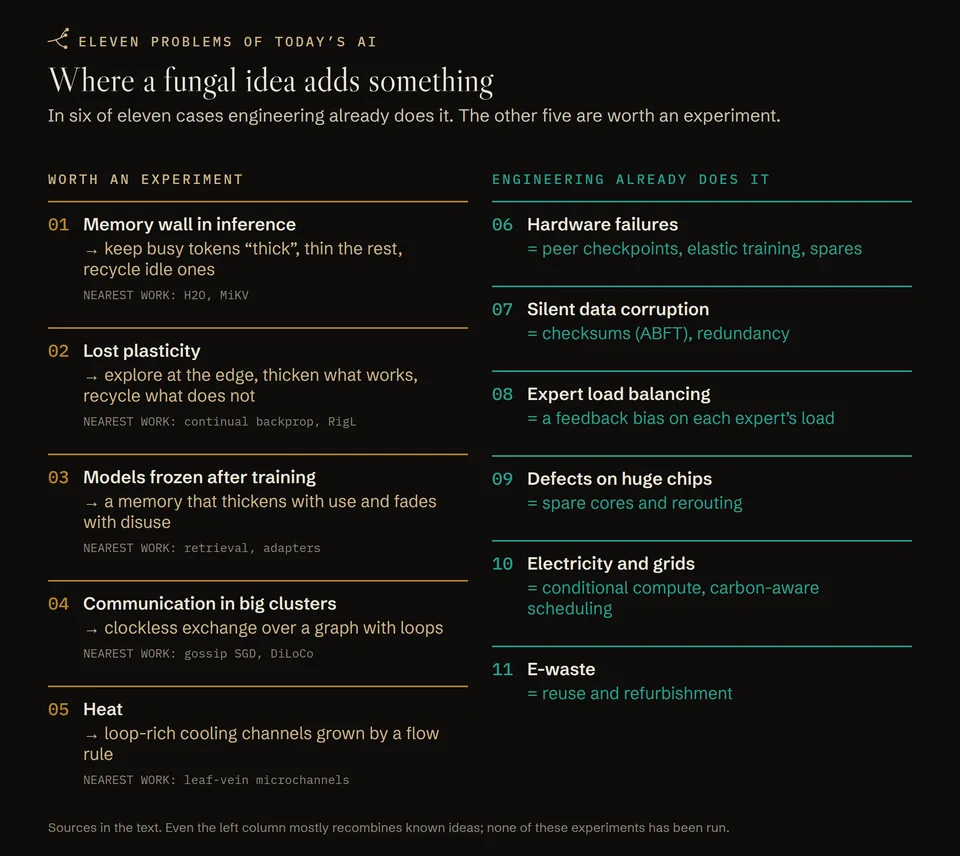
The five problems worth an experiment share one idea: treat a resource as a network of tubes that thicken with use and thin without it, and keep a few loops. Even here, honesty requires a caveat. In each case the fungal version mostly recombines ideas that engineers already have, and what it adds is a specific rule that can be tested and could fail.
- The memory wall during inference. A model could treat each token in its KV cache like a hypha with a “thickness” that grows when the model attends to it and decays otherwise: thick tokens stay in full precision, thin ones are compressed, idle ones are recycled. The H2O “heavy hitter” cache already keeps the most-attended tokens [21], and MiKV already keeps important tokens in high precision and the rest in low precision [22]. The only new element is decay with hysteresis, so a token is not discarded after one quiet moment. The test is simple: compare the policies at the same memory budget on long-context retrieval tasks.
- Lost plasticity. Standard deep networks trained on a long sequence of tasks gradually lose the ability to learn anything new [23]. A mycelium explores with new tips at its edge, thickens productive routes and recycles unproductive ones, including old ones. That is a recipe for staying plastic, not for remembering. Continual backpropagation, which re-initializes a small fraction of rarely used units, and dynamic sparse training already do something similar [23, 24, 25]. A learner that grows, promotes and prunes units by usefulness would be the next experiment.
- Models frozen after training. Model quality tends to decay as the world drifts away from the training data [26]. A deployed model could keep a slowly growing memory layer whose entries strengthen with use and fade with disuse, while the base model stays fixed and auditable. Retrieval-augmented generation already provides memory outside the weights; the fungal idea is a rule for how that memory should grow and decay.
- Communication in large clusters. Large models are trained on thousands of chips that must constantly exchange results. When DeepSeek trained its V3 model across many machines, computation and communication were roughly one to one, which the authors called inefficient [27]. A mycelium shows that a transport network can work without a global clock, moving material along local gradients through a mesh full of loops [28]. The analogous experiment replaces some synchronous global averaging with asynchronous exchanges over a graph with loops. The analogy is loose, and gains, if any, would show up where bandwidth is scarce, for example between data centers.
- Heat. With racks at 120 kW and more, cooling channels matter. Channels could be grown on a chip’s measured heat map with a flow-reinforcement rule, keeping loops on purpose so that one clogged channel does not create a hot spot. Transport-network theory developed for leaf veins already predicts that loops pay off under damage and fluctuating load [29], and vein-like microchannels etched into chips are already being tested [30]. Fungal cords are one more biological example of the same principle.
In the other six cases, the fungus adds a good story and nothing technical. Large training runs survive hardware failures through checkpoints, spare machines and elastic training. Silent data corruption, chips that compute wrong answers without raising any error, appeared in hundreds of CPUs across Meta’s fleet [31] and is fought with checksums and redundancy. Mixture-of-experts models, which route each token to a few specialized sub-networks, already balance the load with a feedback rule; DeepSeek-V3 activates 37 billion of its 671 billion parameters for each token [27]. Wafer-scale chips tolerate defects with small cores, spare cores and rerouting; Cerebras states that each defect costs about a hundred times less silicon than it would on a GPU [32]. Electricity limits are tackled with conditional computation and carbon-aware scheduling. And the e-waste problem, 62 million tonnes in 2022 with only 22% documented as recycled [33], will not be solved by mushroom electronics, which today make sense only for short-lived sensors.
Closing: borrow the rules, not the mushroom
A mycelium does not think, at least not in any sense we would recognize. Yet, without a center and without a plan, it solves a problem that engineers find very hard: building a cheap, robust and efficient network in an environment that keeps changing. Its rules are simple enough to write in one line and powerful enough to carve a transport network out of a uniform mesh. Those rules can be borrowed by silicon today.
There is a bolder question left. What if the rules were borrowed not by silicon but by living human neurons, and the network were allowed to grow the way a fungus grows across a forest? That is the thought experiment of Part 3.
Notes on methods
The cover is a collage made by computer for this series: mushrooms modeled in 3D and engraved by a program, a chip rendered with Blender and printed as halftone, and a mycelium grown by a space-colonization algorithm. The “Grown, not drawn” image, the three-phase panel and the network simulation are original computer simulations made for this series, not photographs. The mycelium model grows tips that branch and fuse on a grid, routes flow toward food sources and thickens the busiest cords. The network simulation implements the adaptive-network equation of Tero et al. (2010), dD/dt = |Q|^μ / (1 + |Q|^μ) − D with μ = 1.6, on 681 nodes; at each step, one food source injects flow and the others absorb it. Illustrations marked as generated with AI are artistic references, not scientific images. Some measurements of fungal electrical activity come from very few studies and are marked accordingly.
References
- Simonin, A., Palma-Guerrero, J., Fricker, M. and Glass, N. L. “Physiological significance of network organization in fungi.” Eukaryotic Cell 11(11): 1345–1352, 2012. DOI
- Lew, R. R. “Mass flow and pressure-driven hyphal extension in Neurospora crassa.” Microbiology 151: 2685–2692, 2005. DOI
- Bebber, D. P., Hynes, J., Darrah, P. R., Boddy, L. and Fricker, M. D. “Biological solutions to transport network design.” Proceedings of the Royal Society B 274: 2307–2315, 2007. DOI
- Heaton, L. L. M. et al. “Growth-induced mass flows in fungal networks.” Proceedings of the Royal Society B 277: 3265–3274, 2010. DOI
- Oyarte Galvez, L. et al. “A travelling-wave strategy for plant–fungal trade.” Nature 639, 2025. DOI
- Tero, A. et al. “Rules for biologically inspired adaptive network design.” Science 327: 439–442, 2010. DOI
- Olsson, S. and Hansson, B. S. “Action potential-like activity found in fungal mycelia is sensitive to stimulation.” Naturwissenschaften 82: 30–31, 1995. DOI
- Adamatzky, A. “On spiking behaviour of oyster fungi Pleurotus djamor.” Scientific Reports 8: 7873, 2018. DOI
- Adamatzky, A. “Language of fungi derived from their electrical spiking activity.” Royal Society Open Science 9: 211926, 2022. DOI
- Fukasawa, Y. et al. “Electrical integrity and week-long oscillation in fungal mycelia.” Scientific Reports 14, 2024. DOI
- Fukasawa, Y., Savoury, M. and Boddy, L. “Ecological memory and relocation decisions in fungal mycelial networks: responses to quantity and location of new resources.” The ISME Journal 14: 380–388, 2020. DOI
- Fukasawa, Y. et al. “Spatial resource arrangement influences both network structures and activity of fungal mycelia: A form of pattern recognition?” Fungal Ecology, 2024. DOI
- Blatt, M. R. et al. “Does electrical activity in fungi function as a language?” Fungal Ecology 68: 101326, 2024. DOI
- Adamatzky, A. “Towards fungal computer.” Interface Focus 8(6): 20180029, 2018. DOI
- LaRocco, J. et al. “Sustainable memristors from shiitake mycelium for high-frequency bioelectronics.” PLOS ONE 20(10): e0328965, 2025. DOI
- Mishra, A. K. et al. “Sensorimotor control of robots mediated by electrophysiological measurements of fungal mycelia.” Science Robotics, 2024. DOI
- Danninger, D. et al. “MycelioTronics: Fungal mycelium skin for sustainable electronics.” Science Advances 8(45): eadd7118, 2022. DOI
- Phillips, N., Gandia, A. and Adamatzky, A. “Electrical response of fungi to changing moisture content.” Fungal Biology and Biotechnology, 2023. DOI
- Roberts, N. and Adamatzky, A. “Mining logical circuits in fungi.” Scientific Reports 12: 15930, 2022. DOI
- Buffi, M. et al. “Electrical signaling in fungi: past and present challenges.” FEMS Microbiology Reviews 49, 2025. DOI
- Zhang, Z. et al. “H2O: Heavy-Hitter Oracle for Efficient Generative Inference of Large Language Models.” NeurIPS, 2023. arXiv
- Yang, J. Y. et al. “No Token Left Behind: Reliable KV Cache Compression via Importance-Aware Mixed Precision Quantization.” arXiv:2402.18096, 2024. arXiv
- Dohare, S. et al. “Loss of plasticity in deep continual learning.” Nature 632, 2024. DOI
- Mocanu, D. C. et al. “Scalable training of artificial neural networks with adaptive sparse connectivity inspired by network science.” Nature Communications 9: 2383, 2018. DOI
- Evci, U., Gale, T., Menick, J., Castro, P. S. and Elsen, E. “Rigging the Lottery: Making All Tickets Winners.” ICML, 2020. arXiv
- Vela, D. et al. “Temporal quality degradation in AI models.” Scientific Reports 12: 11654, 2022. DOI
- DeepSeek-AI. “DeepSeek-V3 Technical Report.” arXiv:2412.19437, 2024. arXiv
- Fricker, M. D., Heaton, L. L. M., Jones, N. S. and Boddy, L. “The Mycelium as a Network.” Microbiology Spectrum 5(3), 2017. DOI
- Katifori, E., Szöllősi, G. J. and Magnasco, M. O. “Damage and fluctuations induce loops in optimal transport networks.” Physical Review Letters 104: 048704, 2010. DOI
- van Erp, R. et al. “Co-designing electronics with microfluidics for more sustainable cooling.” Nature 585: 211–216, 2020. DOI
- Dixit, H. D. et al. “Silent Data Corruptions at Scale.” arXiv:2102.11245, 2021. arXiv
- Cerebras. “100x Defect Tolerance: How Cerebras Solved the Yield Problem.” Company blog. cerebras.ai
- ITU and UNITAR. Global E-waste Monitor 2024. Press release, March 2024. unitar.org